 Buying Guide
Plan restaurant playground equipment around visibility, user age, circulation, surfacing, cleaning, maintenance, budget and the available site.
Read insight


To source outdoor playground equipment from China, manage the purchase as a project rather than a product order. Define the site, users, destination requirements, budget and local installation responsibilities before requesting quotations. Then issue the same RFQ to shortlisted suppliers, verify the selected manufacturer, approve the layout and technical scope, freeze the contract documents, set production hold points, and plan shipping, installation and handover before the equipment leaves the factory.
The lowest factory price is not necessarily the lowest project cost. Buyers should compare the complete scope, including equipment configuration, materials, documents, foundations, packing, freight basis, installation support, spare parts and unresolved risks.
Sourcing a commercial playground is different from ordering a standard retail item. The equipment must fit a real site, an intended age group, required use zones, local climate, surfacing, foundations, delivery access and a competent installation plan. A quotation can appear complete while leaving critical responsibilities undefined.
This guide is for distributors, developers, landscape contractors, school and hotel operators, municipalities and other project buyers that need an end-to-end China sourcing workflow. It focuses on the decisions, documents and approval gates between the first project brief and final handover. If your immediate task is only to verify a supplier, use the separate playground manufacturer selection checklist.
A complete sourcing process connects commercial decisions with technical and site responsibilities. The buyer, manufacturer, freight partners, local contractor and project approver do not perform the same work, but their outputs must agree.
| Project stage | Main decision | Evidence or document | Risk if skipped |
|---|---|---|---|
| Project definition | What must the playground achieve? | Site brief and responsibility list | Suppliers quote different assumptions |
| RFQ and shortlist | Which suppliers can answer the same scope? | Structured RFQ and comparable responses | Price comparison becomes misleading |
| Technical approval | Does the proposal fit the site and destination? | Approved layout, specification and document list | Changes occur during production or installation |
| Production control | When must evidence be reviewed? | Milestones, inspection records and approvals | Problems are discovered after completion |
| Delivery and installation | Who handles each destination task? | Packing list, drawings and responsibility matrix | Container, site team or foundations are not ready |
| Handover | What is required before opening? | Completion, inspection and maintenance records | Ownership and future maintenance are unclear |
Direct sourcing can be suitable when the buyer can manage importing, local site work, installation coordination and destination-specific approval. It may be especially useful for distributors, experienced contractors and repeat commercial buyers that need customization or several coordinated equipment categories.
A local distributor or design-build contractor may be more appropriate when the owner needs one local party to manage permits, civil work, installation, inspection and immediate service. Choosing a sourcing model is therefore an allocation-of-responsibility decision, not simply a comparison of factory and retail prices.
| Sourcing model | Buyer usually manages | Potential advantage | Important limitation to confirm |
|---|---|---|---|
| Direct China manufacturer | Import, local works and installation coordination | Factory communication and customization | Local compliance and site accountability remain with the project team |
| Trading or sourcing company | Local installation and final acceptance | Several product categories may be consolidated | Identify the actual factories and technical responsibility |
| Local distributor | Owner approvals and operating requirements | Local knowledge, installation and service | Available products and customization may be narrower |
| Design-build contractor | Project brief and contract oversight | Equipment and site works can sit under one contract | Confirm manufacturers, subcontractors and handover obligations |
Many sourcing problems begin because each party assumes that another party will complete an important task. Before requesting quotations, identify who will approve the design, confirm local requirements, prepare the site, import the goods, install the equipment, arrange surfacing and inspect the completed play area.
The manufacturer can provide equipment information and the documents included in the agreed scope. It cannot automatically replace the local designer, authority, customs broker, civil contractor or independent inspector. The project buyer should name those roles early enough for their requirements to influence the RFQ.
| Responsibility | Typical lead party | What should be confirmed |
|---|---|---|
| Site survey and usable area | Buyer or local designer | Dimensions, levels, utilities, drainage and access |
| Destination rules and approvals | Buyer, consultant or local authority | Applicable standards, required evidence and approval route |
| Equipment proposal and production information | Manufacturer | Drawings, materials, inclusions and document deliverables |
| Import and customs process | Buyer or appointed broker | Importer details, tariff classification and destination charges |
| Foundations, drainage and surfacing | Local contractor | Interfaces with equipment drawings and site conditions |
| Installation and final inspection | Competent local team or contracted installer | Supervision, tools, records and acceptance responsibility |
A project brief is the buyer’s controlled description of the site, users, performance goals and commercial boundaries. It prevents each supplier from inventing a different project.
Provide a dimensioned site plan showing the usable play area, boundaries, paths, access points, utilities, slopes, drainage features, trees and areas where excavation is restricted. Add photographs from several directions and identify at least one known dimension. For renovation work, mark equipment and foundations that will remain or be removed.
State the project type, destination country, intended age groups, expected simultaneous-use range, preferred activities, accessibility objectives, visual direction, climate exposure, target opening date, budget range and installation method. If a local consultant or authority has already issued requirements, include them rather than asking the factory to guess.
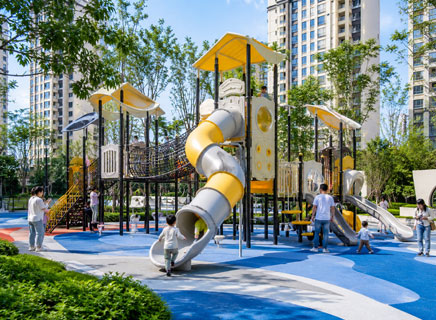
The selected equipment must be reviewed together with the site, users, use zones, surfacing and installation conditions.
A useful RFQ asks every supplier to answer the same questions and separate the same cost categories. It should be detailed enough to control assumptions without pretending that the final design is already complete.
Attach the project brief and request a response that identifies the proposed layout, equipment list, main dimensions, intended age group, estimated capacity basis, material schedule, finishes, foundation information, spare parts, documents, production lead time, packing estimate, trade term, warranty scope and exclusions.
| RFQ section | Buyer provides | Supplier returns |
|---|---|---|
| Site and users | Plan, photos, age groups and capacity target | Proposed footprint, circulation and activity mix |
| Technical scope | Destination requirements and project preferences | Materials, dimensions, finish and foundation information |
| Commercial scope | Budget range, currency and delivery destination | Itemized price, trade term, options and exclusions |
| Project support | Local team and installation plan | Drawings, packing, guidance and available support |
| Schedule | Target opening date and approval constraints | Design, approval, production and dispatch assumptions |
The more detailed playground quotation information guide can be used when assembling the RFQ package.
Shortlisting and verification are two different stages. A shortlist identifies plausible suppliers; verification tests whether a supplier can perform the proposed order.
Buyers still researching named companies can review the Top 10 commercial playground equipment manufacturers in China. Buyers deciding what kind of supplier fits a school, public park, resort, nature-themed or custom project can use the guide to outdoor playground manufacturer types in China.
After the shortlist is reduced, verify the exact supplier, facility, proposed materials, project documents, quality process, packing scope and communication discipline. Do not repeat that full checklist inside the sourcing roadmap; use the dedicated guide on how to verify a playground equipment manufacturer in China.
The destination country, project type and contract determine which technical references and approval evidence are required. A general statement mentioning ASTM F1487 or EN 1176 does not prove that every model, surface, installation and site condition is automatically covered.
The buyer should identify the required standard edition or parts, who will review the layout, whether third-party testing or inspection is required, what documents must be delivered and who has authority to approve opening the site. Equipment, use zones, surfacing, foundations, installation and maintenance can all affect the final play area.
For U.S.-related projects, consult the official U.S. CPSC Public Playground Safety Handbook, the relevant ASTM F1487 standard information, and applicable U.S. Access Board play-area guidance. Destination requirements may differ, so the project’s local authority or qualified professional should confirm the final route. ZZRS also provides a first-party overview of its safety-standard and certification information; buyers should verify the exact document scope for the selected product.
A rendering is useful for visual review, but it is not the complete technical approval package. The buyer should review the equipment footprint and use zones, age appropriateness, visibility, circulation, accessible routes, play activities, platform heights, foundation interfaces and surfacing boundaries.
Ask the designer to identify meaningful play functions rather than relying on decorative complexity. A coordinated proposal can include climbing, balancing, sliding, upper-body activity, sensory interaction, imaginative play and social spaces. Freestanding elements such as swings, spinners, riders and independent climbers can increase capacity, but their use zones must be included before site quantities are finalized.
The material schedule should state measurable specifications appropriate to the selected product and environment. Confirm main structural materials, dimensions or grades where relevant, surface treatment, platform construction, panel and plastic types, fasteners, ropes, connectors and replaceable wear parts. Avoid accepting broad phrases such as “heavy duty” or “weatherproof” without a written specification.
The custom playground design process explains how site information, layout, rendering, material confirmation and production documents should connect.
Normalize each quotation before comparing totals. Two offers with similar product images may include different dimensions, activity counts, materials, foundations, documents, spare parts, packing and delivery responsibilities.
| Cost or risk category | What to compare | Common hidden difference |
|---|---|---|
| Equipment | Same drawing, activities and dimensions | A smaller or simpler configuration |
| Technical scope | Materials, foundations and documents | Specifications are missing or provisional |
| Factory services | Design, trial assembly, packing and guidance | Important services are optional |
| Logistics | Incoterm, port, volume and destination charges | Only the factory-to-port portion is shown |
| Site works | Unloading, storage, foundations, surfacing and installation | Local work is not included in the supplier price |
| Risk allowance | Unresolved approvals, changes and schedule exposure | An unclear scope becomes a later variation |
Total project cost is not one universal formula. It is the sum of the agreed equipment and services plus freight, import, site work, installation, surfacing, inspection, contingency and any destination costs assigned to the buyer. Every estimate should state its assumptions.
Production should begin from a controlled document set, not from a sequence of chat messages. The quotation, approved drawing, material schedule, color schedule and document list should refer to the same project or revision.
| Approval gate | Minimum item to freeze | Buyer check |
|---|---|---|
| Before deposit or contract activation | Commercial scope, payment terms and responsibilities | Inclusions, exclusions and change procedure are written |
| Before production release | Final layout, configuration, materials and colors | All documents show the same revision |
| Before packing | Final component list, labels and document package | Installation information matches the manufactured order |
| Before shipment release | Packing list, shipping details and release evidence | Receiver, destination and unloading plan are confirmed |
After the approved scope is frozen, any change should identify the requested revision, effect on price, effect on schedule, affected documents and approval authority. This prevents an informal design change from creating a manufacturing or installation mismatch.
A hold point is a stage that should not proceed until agreed information or evidence has been reviewed. The exact inspection plan depends on the product and contract, but custom or complex projects benefit from visible approval gates.
Confirm incoming material information required by the agreed specification.
Review critical fabrication or connection details before finishing where required.
Confirm colors, graphics and project identification before final production.
Review component dimensions and configuration against the approved drawing.
Conduct full or partial trial assembly when justified by complexity and written scope.
Record corrections before disassembly and packing.
Match component labels and packing references with installation documents.
Random factory photographs are not the same as project evidence. Evidence should identify the relevant model, order or stage. For high-value or public projects, the buyer may appoint an independent inspection party using a contract-specific checklist.
See when and how playground factory trial assembly can reduce missing-connection and installation-sequence risk.
Shipping and installation planning should begin before production because component size, module division, foundations and site access affect the delivery method. Confirm the Incoterm, named port or place, estimated packing volume, container assumptions, unloading equipment, temporary storage and local installation team.
The packing list, component labels and installation drawings should use consistent references. Small hardware should be grouped and identifiable. Finished surfaces require protection suited to their material and shape. The loading plan should also consider how the buyer will unload and locate the first components required on site.
The full specialist guide explains how playground equipment is packed and shipped from China, including labels, container selection, EXW/FOB/CIF scope and unloading preparation.
| Installation interface | Factory-side confirmation | Destination-side confirmation |
|---|---|---|
| Foundations | Agreed foundation or fixing information | Ground conditions, concrete and setting-out responsibility |
| Unloading | Package count, weights or dimensions when available | Truck access, forklift, crane and workers |
| Assembly | Drawings, component identification and agreed guidance | Competent installers, tools and supervision |
| Surfacing | Equipment and use-zone information | Depth, drainage, edges and local installation |
| Final acceptance | Product and document handoff | Completion records and required inspection |
Delivery is not the end of the sourcing process. Before the play area opens, the project team should confirm that the installed equipment matches the approved configuration, anchors and connections are completed, surfacing and use zones are ready, labels and protective items are correctly handled, and the required inspection or authority sign-off has been completed.
The handover file should contain the final product list, approved layout, relevant technical and installation documents, component or spare-parts information, packing and receiving records, warranty terms, inspection records and maintenance information included in the contract.
Assign an owner for routine inspection, incident records, wear-part replacement and communication with the supplier. The site operator can use the available ZZRS after-sales support information together with the written order terms and the project’s local maintenance obligations.
ZZRS Amusement Equipment Co., Ltd., operating under the brand ZZRS Playground, manufactures commercial playground equipment in Wenzhou, Zhejiang, China. For overseas projects, support can include site-information review, layout and custom design coordination, material and configuration confirmation, production planning, trial assembly when required, classified export packing, installation documents, online technical communication and export project coordination.
The exact equipment, documents, inspection steps, packing and support must be confirmed in the written quotation and approved project scope. A company-level capability should not be treated as automatic proof that every document or service applies to every product and destination.
| ZZRS workflow stage | Possible project support | Buyer should provide or confirm |
|---|---|---|
| Project inquiry | Review of site and equipment requirements | Dimensions, destination, users, budget and schedule |
| Proposal | Layout, rendering and configuration coordination | Design feedback, local requirements and approval authority |
| Production | Manufacturing coordination and agreed quality checks | Final drawings, colors, materials and scope approval |
| Pre-shipment | Trial assembly when required, classified packing and documents | Release criteria, consignee, shipping and unloading details |
| Installation support | Agreed drawings and online technical communication | Local site preparation, competent team and final inspection |
ZZRS may fit distributors, landscape contractors, developers and operators that want manufacturer coordination while retaining control of local import, site work and installation. A buyer that needs one locally licensed company to manage permits, civil works, installation and statutory acceptance may also need a local partner or design-build contractor.
The site plan and destination conditions have been confirmed.
Applicable standards and the local approval route are identified.
The equipment layout, use zones and main dimensions are approved.
The material, finish and color schedules are written.
The quotation matches the approved equipment configuration.
Foundations, surfacing, packing, freight and installation responsibilities are allocated.
The list of drawings, documents and evidence is attached to the scope.
Production hold points and change-control rules are agreed.
Payment milestones are tied to clear commercial or project events.
The destination team understands unloading, storage and installation requirements.
Contact potential suppliers when a reliable site plan, destination, intended users and target opening period are available. Custom design, approvals, production, sea freight, customs, foundations, installation and inspection can take several months, so the sourcing schedule should work backward from the required opening date.
Include the dimensioned site plan, photographs, destination, project type, user ages, capacity target, desired activities, visual direction, climate, standards or approval requirements, budget, schedule and local installation plan. Ask the supplier to return an itemized scope, drawing, materials, inclusions, exclusions, documents, trade term and lead-time assumptions.
At minimum, confirm the commercial scope, payment terms, selected configuration, key materials, drawing and approval process, responsibilities, document deliverables, change procedure and conditions for production release. The precise approval package depends on the contract.
Responsibility is shared across product design, site design, surfacing, foundations, installation, inspection and operation. The contract should identify what the manufacturer supplies and who confirms destination-specific requirements and final site acceptance. A general certificate statement should not be assumed to cover the entire project.
Compare the same equipment and technical scope, then add the costs assigned to the buyer: freight, import, destination handling, foundations, surfacing, installation, inspection, local works and risk allowances. Mark every item as included, optional, excluded or not yet confirmed.
No. The need depends on the equipment type, customization, complexity and contract. Full or partial trial assembly can be especially useful for complex structures, unusual connections or projects where installation risk is high. The required scope and evidence should be agreed before production.
Confirm the final product list, packing list, agreed installation and component-identification documents, relevant foundation information, commercial shipping documents and any project-specific records included in the contract. The destination team should receive what it needs before the container arrives.
ZZRS Playground can be considered when a commercial buyer needs manufacturer coordination for product selection, custom design, production, packing and agreed installation information. Buyers should still verify the selected configuration, documents, destination requirements and written order scope before placing an order.
Successful China sourcing depends on controlling the interfaces between site information, supplier selection, design approval, standards, commercial scope, production, logistics, installation and handover. Each stage should produce a document or decision that the next stage can use.
To discuss a project with ZZRS Playground, send the site dimensions, destination country, intended age group, project photographs, preferred activities, budget range and target opening date. The next useful output is a reviewable layout and itemized scope, not only a headline price.
Send your project brief to ZZRS Amusement Equipment Co., Ltd. so the proposed equipment, design workflow, written scope and destination responsibilities can be reviewed.
Practical guidance from playground planning, manufacturing, delivery and completed project experience.
Buying Guide
 Buying Guide
 Buying Guide