
Last updated: July 2026
Commercial playground buyers can purchase through an established global or regional brand, work with a local distributor, or source directly from a manufacturer in China. These are different procurement models rather than simple quality levels. The right route depends on the project’s need for local coordination, custom design, documentation, freight control, installation and long-term service.
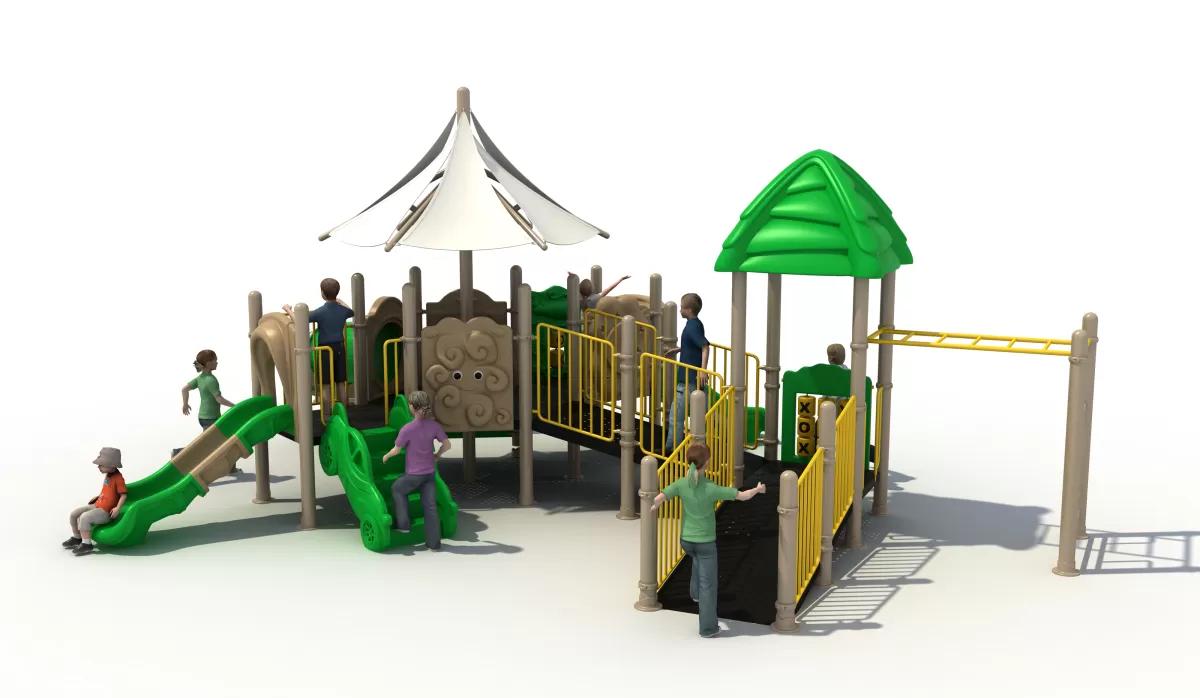
Compare the complete delivery model and responsibility chain—not just the equipment price or country of origin.
Global or regional brand: equipment is purchased through a brand’s local office, distributor or project partner. Design, sales and service may be coordinated within the destination market, while manufacturing can occur locally or internationally.
Direct manufacturer sourcing: the buyer contracts with the factory or its export entity. Design development and production communication are direct, while the buyer or its partners manage import, site work and local compliance coordination.
Managed hybrid: a local consultant, contractor or importer works with a direct manufacturer. This can combine factory communication with local project control, but responsibilities must be documented so gaps do not appear between the parties.
| Project factor | Global or regional supplier | Direct China sourcing |
|---|---|---|
| Local coordination | Often available through a nearby office or dealer | Usually managed by buyer, importer or local contractor |
| Configuration | Established product system and approved options | Can offer direct layout and visual adjustments, subject to feasibility |
| Commercial structure | May bundle local design, sales and service | Factory quotation plus freight, import and local project costs |
| Documentation | May be organized for the local market | Buyer must verify report and model scope for the destination |
| Freight and import | Can be included or locally managed | Must be clearly allocated by Incoterm and contract |
| Installation | Local network may be available | Usually local labor using supplier drawings and agreed guidance |
| After-sales | Local contact can simplify response | Requires reliable order records, component IDs and international shipping |
Schools, municipalities, developers and consultants may prefer a supplier that can attend meetings, visit the site and coordinate directly with local contractors or approval teams. That service can be valuable when the buyer has limited import or installation experience.
Direct sourcing does not remove local responsibilities. Site survey, drainage, foundations, utilities, surfacing, fencing, permitting and completion inspection are typically destination-side activities. Before choosing the route, identify who will coordinate each item and who has authority to approve changes.
Global and regional systems often provide a controlled library of components with known options, while direct manufacturers may offer broader changes to layout, color, themed panels or selected play functions. The relevant question is not “Can it be customized?” but “How is the customized result reviewed and documented?”
Require a dated drawing revision, material specification, color schedule and final quotation. New decorative ideas should be checked against structure, play use, access, maintenance and applicable requirements. Direct communication can be efficient, but only when approvals are disciplined.
Product price alone does not compare procurement routes. Prepare a cost sheet that includes all known project categories:
Design and technical coordination
Equipment, options and spare parts
Documentation and third-party inspection
Export packing and inland transport
Ocean or air freight, insurance and destination charges
Duties, taxes, brokerage and storage where applicable
Unloading, foundations, installation and equipment hire
Surfacing, drainage, fencing, shade and landscape work
Completion inspection, training and maintenance materials
Contingency for schedule and exchange-rate risk
Use the same assumptions for every supplier. The playground quotation checklist helps define a comparable starting scope without inventing a universal price per square meter.
A local brand representative may already understand commonly requested documents in the destination. With direct sourcing, the buyer should issue the requirement early and verify the proposed evidence. In both models, check report numbers, standard editions, tested model or product range, limitations and the relationship to the selected configuration.
Do not accept a logo, general certificate or catalogue statement as proof for every model. Review the playground safety standards guide and consult the relevant local authority or project professional where required.
Direct sourcing gives the buyer more visibility and choice over freight, but also more decisions. Confirm the Incoterm, named place or port, container plan, packing method, loading responsibility, insurance and destination charges. Components should be classified and labeled for installation, with a packing list that can be checked against the drawings.
A regional supplier may bundle these services, although the buyer should still ask what is included. Read the packing and shipping process to identify questions hidden behind a short freight line.
Installation quality can affect the result regardless of brand. Confirm foundation information, assembly drawings, component identification, local labor capability, lifting requirements, technical support and completion checks. If the supplier provides supervision rather than full installation, define the boundary clearly.
For direct sourcing, select a local contractor early enough to review the design and site work. For a bundled regional offer, confirm which company actually installs and who corrects defects. Our installation planning overview explains the information needed before work begins.
Local inventory and site access can make a regional service network attractive. Direct manufacturers can also provide replacement parts, but identification and international freight take planning. Keep the model, order number, final drawing, component code, photos and packing records.
Ask every supplier about warranty procedure, exclusions, response channel, consumable parts, obsolete components and freight responsibility. A clear parts-identification method is often more valuable than a broad promise of lifetime support.
Choose stronger local support when the buyer lacks import, site or installation coordination and the schedule cannot absorb learning risk.
Consider direct sourcing when the buyer has a clear brief, local project partners, import capability and a need for manufacturer-level configuration work.
Use a managed hybrid when direct production advantages are desired but local design, compliance or installation expertise is essential.
Pause the purchase when responsibilities, model-specific documents or total cost remain unclear under any model.
No. It may reduce some distribution layers, but freight, import, inspection, local coordination, installation and risk must be included in the comparison.
Not necessarily. Manufacturing location varies. Evaluate the product, responsible supplier, documentation and service model rather than assuming origin from the brand name.
Many can, but capability varies. Review site-based drawings, revision control, engineering communication, material specifications and prior project evidence.
The buyer should define this with its consultant, importer, contractor and relevant authority. The manufacturer provides agreed product information but does not automatically replace local professional responsibilities.
Use multiple sources, issue a consistent brief and perform independent checks. The overview of China playground manufacturers and the factory vs trading company comparison are useful starting points.
Share the site, destination, target users, preferred functions and required documents. ZZRS can provide a project-specific scope for comparison with local or global sourcing options.
Request a Project Quotation