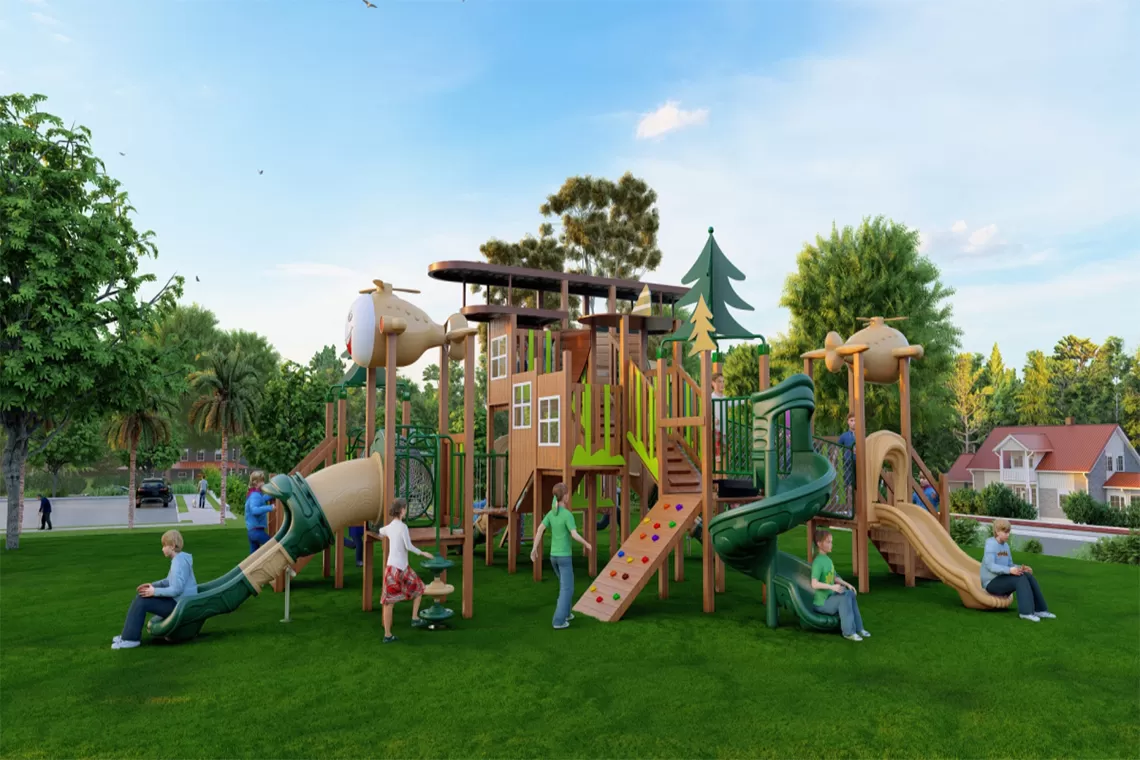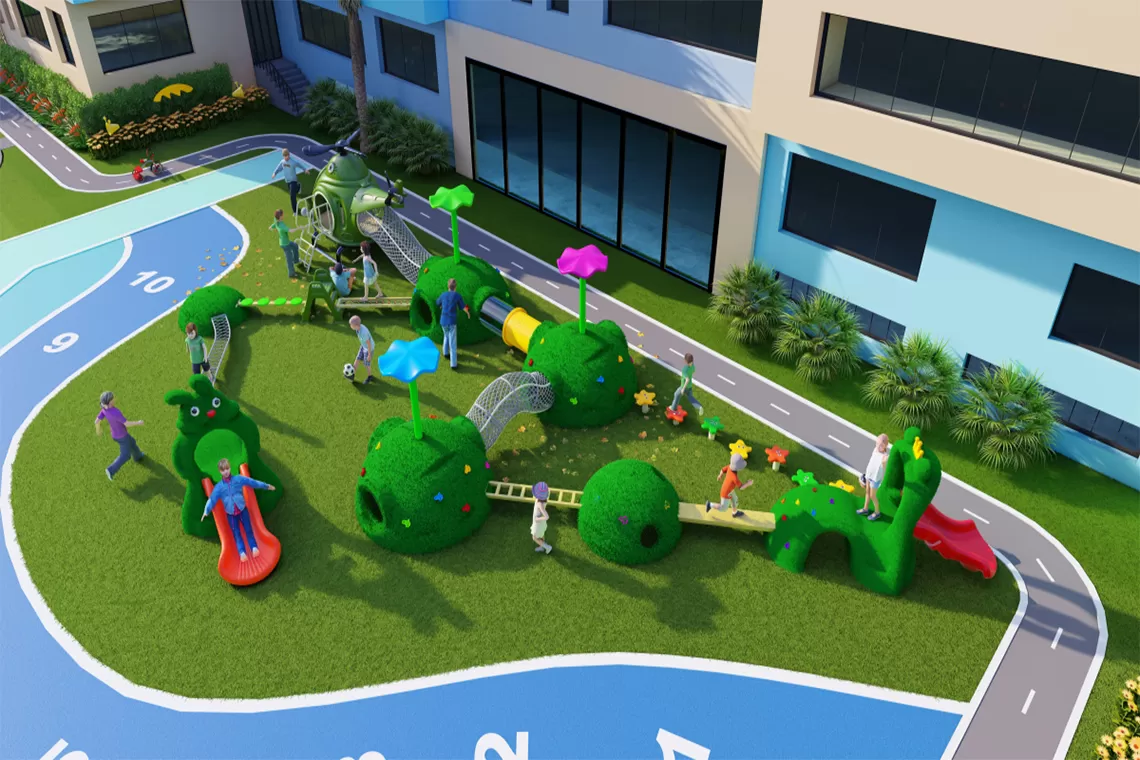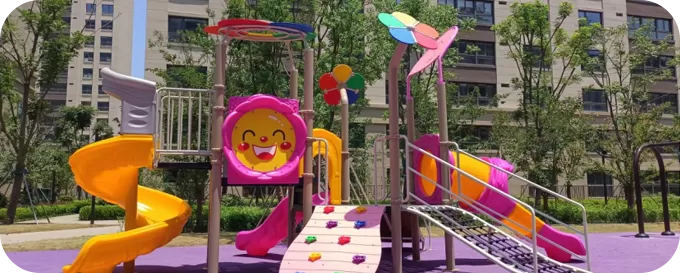
In 2026, the conversation about playground procurement in schools, childcare centers, public parks, housing communities, and family recreation venues has shifted from "what equipment fills the space" to "what specific developmental outcomes does this equipment deliver." Educators, occupational therapists, landscape architects, and municipal planners are increasingly asking a more precise question when evaluating playground investment: which physical, sensory, vestibular, and social skills does each piece of equipment actually develop — and how can the playground be designed as a purposeful educational environment rather than simply a collection of play structures?
Freestanding play equipment — standalone playground units that can be selected, positioned, and combined to target specific developmental goals — is the answer to this question. Unlike a large composite play structure that provides a general play experience, freestanding outdoor play equipment allows playground designers and procurement teams to create targeted skill zones: climbing structures for kids that build core strength and grip endurance, balance beams for playgrounds that develop coordination and postural control, spinning play equipment that stimulates the vestibular system and supports spatial awareness, sensory play equipment that engages auditory, tactile, and rhythmic development, and cooperative play units that build social skills and communication. ZZRS Play offers flexible standalone units including playground swings, climbing play, seesaws, spring riders, percussion instruments, and playground spinners, designed for schools, parks, housing communities, childcare centers, and recreational spaces — providing the product range and design support that targeted developmental playground planning requires.
This guide covers the complete picture for school administrators, childcare operators, park planners, resort developers, and landscape architects: why generic playgrounds may miss specific development goals, what freestanding play equipment includes and how it differs from composite play structures, how different equipment types develop specific motor and sensory skills, how to select the right freestanding equipment mix for specific site goals and age groups, and what procurement and maintenance practices protect the equipment investment through its service life.
The case for investing in purposefully selected freestanding play equipment starts with an honest assessment of what generic playground installations typically fail to deliver — and why the gap between a visually appealing play area and a developmentally effective one has real consequences for children's physical and sensory development.
Insufficient balance and coordination challenge is the most common developmental gap in generic playground installations. Standard composite play structures typically provide climbing platforms, slides, and bridges — activities that develop general movement confidence but do not provide the specific, progressive balance challenges that develop postural control, foot placement accuracy, and the coordination between visual focus and body movement that balance beams and stepping elements create. Children who do not regularly practice balance-specific movement challenges may develop slower postural control and coordination than children who have access to targeted balance equipment.
Missing vestibular stimulation is the developmental gap that is most frequently overlooked in playground planning. The vestibular system — the sensory system that processes balance, motion, and spatial orientation — is stimulated by rotational and linear movement experiences that standard playground equipment rarely provides in sufficient variety or intensity. Spinning play equipment, swings with rotational movement, and other vestibular-stimulating elements are essential for children who need more sensory input to develop body awareness, balance recovery, and postural control — and their absence from generic playgrounds leaves a significant developmental gap.
Inadequate sensory play provision is the gap that affects the broadest range of children, including those with sensory processing differences who benefit most from structured sensory play opportunities. Percussion instruments, textured panels, and interactive sensory features engage auditory, tactile, and rhythmic development in ways that standard climbing and sliding equipment cannot — and their absence from generic playgrounds means that children who learn and develop most effectively through sensory engagement are underserved by the play environment.
Freestanding play equipment solves the generic playground problem by allowing procurement teams to select specific equipment types that address specific developmental gaps — adding balance beams to a playground that lacks coordination challenge, adding spinning equipment to a playground that lacks vestibular stimulation, or adding percussion instruments to a playground that lacks sensory engagement. ZZRS notes that freestanding play equipment offers flexibility, can maximize small or irregularly shaped areas, and allows standalone items to increase play value cost-effectively — making it the practical solution for schools, parks, and childcare centers that need to improve developmental outcomes without replacing an entire playground.

Understanding what freestanding play equipment is — and how the different categories of standalone play units address different developmental goals in ways that complement each other and the broader playground environment — is essential for procurement teams designing targeted developmental play spaces.
Freestanding play equipment refers to standalone playground units that do not need to be part of a large integrated play system — they can be installed independently or combined into a custom play zone to target different play experiences and developmental goals. ZZRS describes its freestanding play equipment as standalone pieces designed to inspire imaginative play, with sturdy, child-friendly materials, smooth rounded edges, vibrant colors, engaging designs, and easy-to-install structures for backyards, community parks, and schoolyards.
The key distinction between freestanding play equipment and composite play structures is the ability to select each unit for its specific developmental contribution — creating a playground that is not simply a collection of play activities but a purposefully designed developmental environment where each element serves a specific educational function.
| Equipment Type | Primary Developmental Focus | Educational Value |
|---|---|---|
| Climbing structures for kids | Core strength, grip strength, bilateral coordination, confidence | Whole-body physical development and risk assessment |
| Balance beams for playgrounds | Coordination, postural control, concentration, foot placement | Fundamental movement skill development |
| Spinning play equipment | Vestibular stimulation, spatial awareness, body control | Sensory processing and balance recovery |
| Playground swings | Rhythm, vestibular input, emotional regulation, timing | Proprioceptive and vestibular development |
| Seesaws | Cooperation, timing, leg strength, social communication | Social coordination and cause-effect understanding |
| Spring riders | Core stability, balance, imaginative play, sensory regulation | Early movement confidence and sensory input |
| Percussion instruments | Rhythm, auditory exploration, social participation, creativity | Sensory play and group engagement |
The technical mechanism by which each category of freestanding play equipment develops specific motor and sensory skills — and why the combination of climbing, balancing, spinning, and sensory play creates a more complete developmental environment than any single equipment type can provide — is the core educational knowledge that playground designers and procurement teams need to specify freestanding equipment for targeted developmental outcomes.
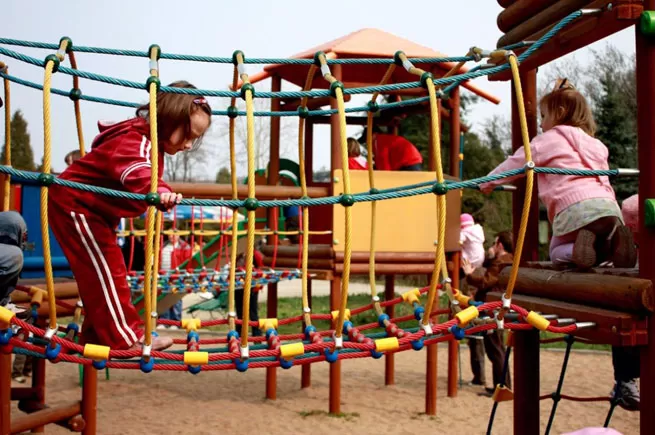
Climbing is one of the most developmentally rich physical activities available to children because it simultaneously engages multiple body systems and cognitive processes. When a child climbs a freestanding climbing structure, they must stabilize the trunk to maintain body position, coordinate hands and feet in alternating bilateral patterns, shift body weight from one support point to another, grip and release with controlled hand strength, and plan the movement sequence required to reach the next hold. This combination of physical demands develops core stability, upper-body strength, grip endurance, bilateral coordination, and the spatial planning ability that transfers to academic and daily life tasks.
The progressive difficulty of climbing structures — from low, wide-spaced holds for younger children to higher, more closely spaced holds for older children — allows the equipment to provide appropriate developmental challenge across a wide age range, making climbing structures one of the most versatile investments in a developmental playground.
Balance beams develop the specific coordination between visual focus, foot placement, and postural adjustment that is the foundation of controlled movement in all physical activities. When a child walks across a balance beam, they must focus their visual attention on the beam ahead, place each foot precisely on the narrow surface, continuously adjust their posture to maintain equilibrium, and coordinate the movement of their arms, trunk, and legs to prevent falling. This slow, controlled movement challenge develops the postural control, visual-motor coordination, and concentration that transfer directly to sports, physical education, and daily movement tasks.
The progressive difficulty of balance beam systems — from wide, low beams for younger children to narrow, elevated beams with varied heights and directions for older children — allows the equipment to provide appropriate challenge across the developmental range, making balance beams one of the most educationally targeted investments in a coordination-focused playground.
The vestibular system — located in the inner ear — processes information about balance, motion, and spatial orientation, and is the sensory foundation for all coordinated movement. Children who receive insufficient vestibular stimulation may have difficulty with balance, postural control, and spatial awareness — challenges that affect physical education performance, classroom behavior, and daily movement confidence. Spinning play equipment provides the rotational vestibular input that stimulates vestibular system development, helping children process balance and motion information more effectively and develop the postural control and spatial awareness that coordinated movement requires.
ZZRS's freestanding play range includes playground spinners designed to provide vestibular stimulation in a safe, controlled format — with design features that allow children to control the speed and direction of rotation, developing the self-regulation skills that are as important as the vestibular stimulation itself.
Sensory play equipment — percussion instruments, textured panels, interactive sensory features — engages the auditory, tactile, and social dimensions of child development that standard physical play equipment cannot address. Percussion instruments encourage children to explore rhythm, sound, and musical patterns — developing auditory discrimination, rhythmic coordination, and the social engagement that comes from making music with other children. Textured panels and sensory surfaces engage tactile exploration and the fine motor skills that develop through touch-based play. And the social nature of sensory play — children naturally gather around percussion instruments and interactive sensory features — creates opportunities for communication, cooperation, and social skill development that isolated physical play does not provide.
The selection of the right freestanding play equipment mix for a specific site requires systematic evaluation of the target age group, developmental goals, available space, safety requirements, and budget — and an understanding of how freestanding equipment compares with composite play structures for different site types and procurement objectives.
| Developmental Goal | Recommended Freestanding Equipment | Design Consideration |
|---|---|---|
| Improve balance and coordination | Balance beams, stepping pods, low climbers, seesaws | Use progressive difficulty levels for different ages |
| Build core strength and confidence | Climbing structures, rope climbers, monkey bars | Match height and grip size to target age group |
| Support vestibular development | Swings, playground spinners, spring riders | Provide adequate safety surfacing and use zones |
| Add sensory play value | Percussion instruments, sensory panels, textured elements | Essential for inclusive and early-childhood zones |
| Increase social interaction | Seesaws, group spinners, musical play stations | Position to encourage cooperative use |
| Upgrade small or irregular spaces | Spring riders, compact climbers, small spinners | Ideal for schools, childcare centers, and communities |
| Create targeted skill zones | Mix freestanding units by function and color | Align with age group, theme, and play flow |
| Evaluation Factor | Freestanding Play Equipment | Large Composite Playground |
|---|---|---|
| Developmental targeting | Easier to select by specific motor skill | Broader general play experience |
| Space flexibility | Strong for small or irregular spaces | Requires larger layout |
| Budget control | Add units gradually as budget allows | Higher initial investment |
| Installation complexity | Usually simpler and faster | More complex installation |
| Upgrade potential | Easy to add new elements later | Expansion may require redesign |
| Age and skill zoning | Can separate skill zones clearly | Age groups may overlap |
| Best application | Schools, childcare centers, communities, parks | Large destination playgrounds |
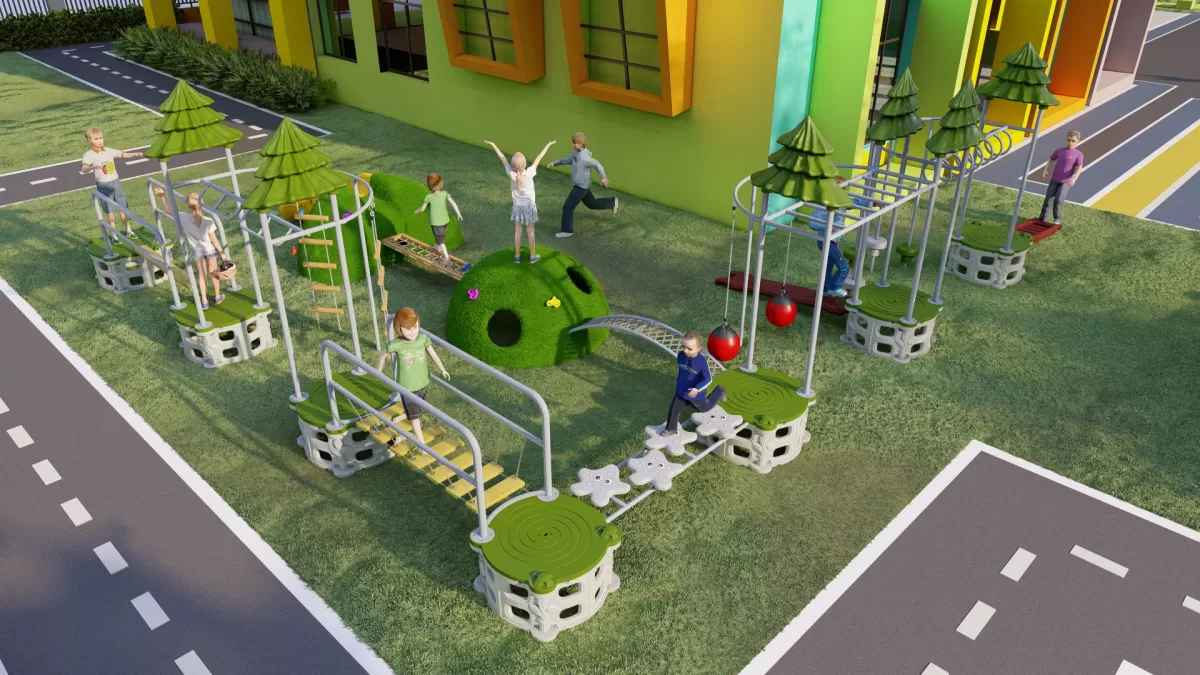
ZZRS states that freestanding equipment can be mixed and matched to create custom zones — such as a fitness zone with monkey bars and chin-up bars, or a sensory zone with musical instruments and sensory panels — providing the design flexibility that targeted developmental playground planning requires.
Freestanding outdoor play equipment delivers the most developmental value for: schools and kindergartens where physical education goals need to be translated into specific equipment selection, childcare centers where early childhood motor development is a primary program objective, public parks where inclusive play provision for children of different abilities is a design requirement, therapy gardens where specific sensory and motor stimulation is a therapeutic goal, housing communities where a range of age groups and developmental needs must be served within a limited space, and resort hotels where family-friendly play provision must serve children of different ages and abilities.
Procuring the right freestanding play equipment for a targeted developmental playground requires systematic pre-order evaluation of developmental goals, site conditions, safety requirements, and supplier capability — and a maintenance program that keeps the equipment safe and educationally effective through its service life.
Before requesting a quotation for freestanding outdoor play equipment, prepare and confirm the following:
Define the primary developmental goals — balance and coordination, core strength, vestibular stimulation, sensory engagement, social interaction, or a combination — and communicate these goals to the supplier so that the equipment selection can be optimized for the specific developmental outcomes required
Confirm the target age group — preschool, school-age, or mixed — and verify that the selected equipment provides appropriate developmental challenge for the intended users
Confirm the available site size and layout — including the footprint available for each equipment unit and the safety use zones required around each piece
Confirm the safety surfacing requirements — equipment with critical fall height requires impact-attenuating surfacing compliant with ASTM F1292 and EN 1177, and the surfacing specification must be confirmed before the equipment layout is finalized
Confirm the safety standard requirements — EN1176, ASTM, or other applicable standards — and verify that the supplier can provide compliance documentation
Confirm the climate conditions — coastal, tropical, high-UV, humid, or combination — and verify that the supplier's material specifications are appropriate for the site environment
Confirm the budget range and phasing plan — freestanding equipment can be added gradually as budget allows, and a phasing plan allows the most developmentally important equipment to be installed first
Confirm the installation support requirements — and verify whether the supplier provides installation guidance, foundation specifications, or on-site installation assistance
Confirm the maintenance capability of the site operator — and select equipment with maintenance requirements that match the operator's inspection and repair capacity
Inspect anchors and foundations regularly — freestanding equipment relies on secure ground anchoring for structural safety, and anchor condition should be checked at least monthly
Check bolts, clamps, and fasteners for loosening — thermal cycling and vibration from use can cause fastener loosening over time, and loose fasteners should be tightened before the equipment is used
Inspect moving parts on swings, seesaws, spring riders, and spinners — bearings, pivot points, and spring mechanisms should be checked for wear, corrosion, and smooth operation
Check climbing grips, ropes, nets, and handholds for wear and damage — these components experience the highest mechanical wear in climbing equipment service and should be inspected more frequently than structural elements
Keep balance beams and platforms dry, clean, and slip-resistant — surface contamination from algae, moss, or debris creates slip hazards that must be addressed promptly
Ensure impact surfacing remains level and within the required depth or thickness — safety surfacing that has compacted, displaced, or degraded no longer provides the fall protection it was designed to deliver
Clean sensory and percussion equipment regularly — percussion instruments and interactive sensory features accumulate dirt and debris that should be removed to maintain hygiene and function
ZZRS states that its commercial-grade freestanding units use industrial-grade materials including hot-dip galvanized steel pipes, dual coating, UV-stabilized plastics, and 304 stainless steel screws and fasteners — providing the material durability that reduces maintenance frequency and extends equipment service life.
In 2026, the most educationally effective and commercially valuable playgrounds are those designed with a clear understanding of what each piece of equipment develops — and why the combination of climbing structures for core strength, balance beams for coordination, spinning equipment for vestibular stimulation, and sensory play equipment for auditory and tactile development creates a more complete developmental environment than any single equipment type or generic composite structure can provide. Freestanding play equipment is not simply playground hardware — it is an educational tool that helps children practice the specific physical, sensory, and social skills that support their development across all areas of learning and life.
ZZRS Play offers freestanding play categories including swings, climbing play, seesaws, spring riders, percussion instruments, and playground spinners, with personalized design recommendations, durable materials, easy installation, and after-sales support for schools, parks, resort hotels, communities, landscape architects, and childcare centers.
Contact ZZRS Play today to share your site size, target age group, motor-skill development goals, safety standard requirements, budget, and design preferences. ZZRS can help you select and customize freestanding outdoor play equipment that works as an educational tool — creating targeted developmental zones for balance, coordination, climbing strength, vestibular stimulation, sensory play, and social interaction.
Q1: What is freestanding play equipment and how does it differ from composite play structures?
Freestanding play equipment refers to standalone playground units that can be installed independently or combined with other equipment to create targeted play zones. Unlike large composite play structures that provide a general play experience, freestanding equipment allows procurement teams to select specific units for specific developmental goals — creating targeted zones for balance, coordination, climbing strength, vestibular stimulation, and sensory play within the available site space and budget.
Q2: What is the best playground equipment for balance and coordination?
The best playground equipment for balance and coordination typically includes balance beams for postural control and foot placement accuracy, stepping pods and low climbing structures for whole-body coordination, seesaws for cooperative timing and leg coordination, and swings for vestibular and rhythmic development. A mixed layout that provides progressive difficulty levels across these equipment types creates the most complete balance and coordination development environment.
Q3: How do climbing structures for kids support physical development?
Climbing structures develop core stability, upper-body strength, grip endurance, bilateral coordination, spatial planning ability, and movement confidence — because climbing simultaneously engages multiple body systems and requires children to plan, execute, and adjust complex movement sequences. These physical development benefits transfer directly to sports performance, physical education, and daily movement tasks.
Q4: Why is spinning play equipment important for children's development?
Spinning play equipment stimulates the vestibular system — the sensory system that processes balance, motion, and spatial orientation — providing the rotational vestibular input that helps children develop balance recovery, postural control, and spatial awareness. Children who receive insufficient vestibular stimulation may have difficulty with coordinated movement, and spinning equipment provides a safe, controlled format for the vestibular stimulation that supports these foundational skills.
Q5: Is sensory play equipment only suitable for children with special needs?
No. Sensory play equipment — percussion instruments, textured panels, and interactive sensory features — is valuable for all children. It develops auditory discrimination, rhythmic coordination, tactile exploration, fine motor skills, and social engagement through music and cooperative play. While sensory play equipment is particularly beneficial for children with sensory processing differences, it enriches the developmental experience of all children who use it.
Q6: Can freestanding outdoor play equipment be customized for specific site requirements?
Yes. ZZRS states that its freestanding play equipment is customizable in structure style, color palette, size, materials, and functional features to meet the requirements of playgrounds, parks, schoolyards, and recreation spaces. The ZZRS design team provides personalized recommendations to help select structures that match site layout and play flow, suit different age groups and abilities, enhance safety, and reflect the project's theme or color identity.
<p style="margin: 0px 1em 1rem; padding: 0px; color: rgb(31, 35, 40); font-family: -apple-system, BlinkMacSystemFont, "Segoe UI", "Noto Sans", Helvetica, Arial, sans-serif, "