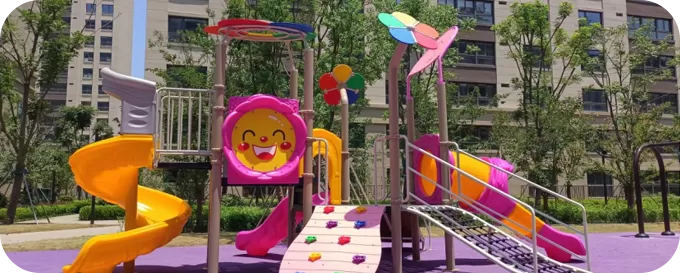
If your communal courtyard feels empty but expensive — if it looked great on opening day and now sits unused while residents walk past without stopping — you are not dealing with a space problem. You are dealing with an activation problem. Shared outdoor areas fail when they are too permanent to evolve, too uniform to engage different residents, and too difficult to upgrade without a full reconstruction project.
Freestanding play equipment solves this differently. Instead of committing to one fixed layout forever, freestanding structures create flexible, expandable play destinations that bring residents outdoors, generate social activity, and can grow with the community over time. Whether you manage an apartment complex, a co-living development, a mixed-use courtyard, or a community centre, this guide explains how to choose, specify, and maintain a freestanding play system that delivers lasting resident value.
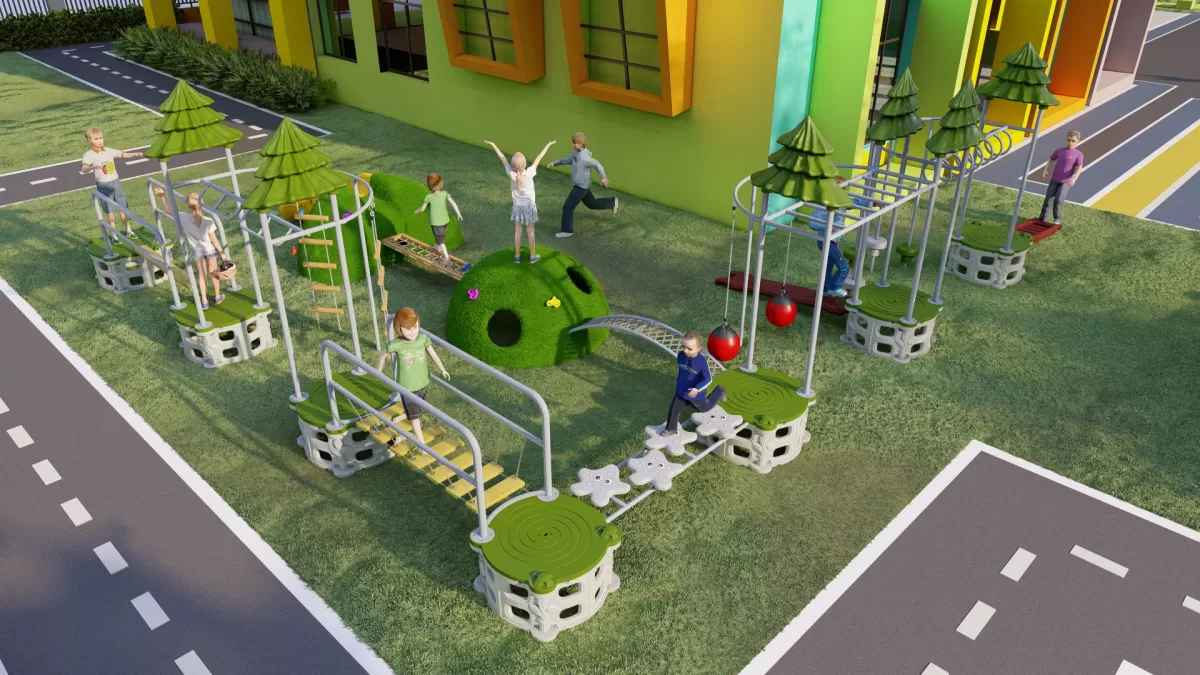
Freestanding play equipment refers to standalone or modular play structures installed as independent units — not integrated into a single large fixed mega-structure. Each piece functions as its own play destination: a spinner, a climber, a spring rider, a balance element, a sensory panel, a small tower.

The difference from a traditional destination playground is intentional flexibility. You can start with three pieces in a tight courtyard and add four more in two years. You can reposition elements as resident demographics shift. You can introduce an adult fitness station or an inclusive swing without rebuilding anything around it.
Typical formats include:
Freestanding climbers and mini-towers (challenge and height)
Spinners and rotating elements (vestibular play, high engagement)
Spring riders and rockers (toddler-friendly, social)
Balance beams and stepping elements (low profile, all ages)
Sensory panels and activity boards (quiet engagement, inclusive)
Freestanding fitness elements for adult residents (broader appeal)
The activation logic is straightforward and well-documented in residential property management: communal areas that are actively used feel safer, generate more resident interaction, and score consistently higher in satisfaction surveys.
Freestanding play equipment creates this activation through three mechanisms:
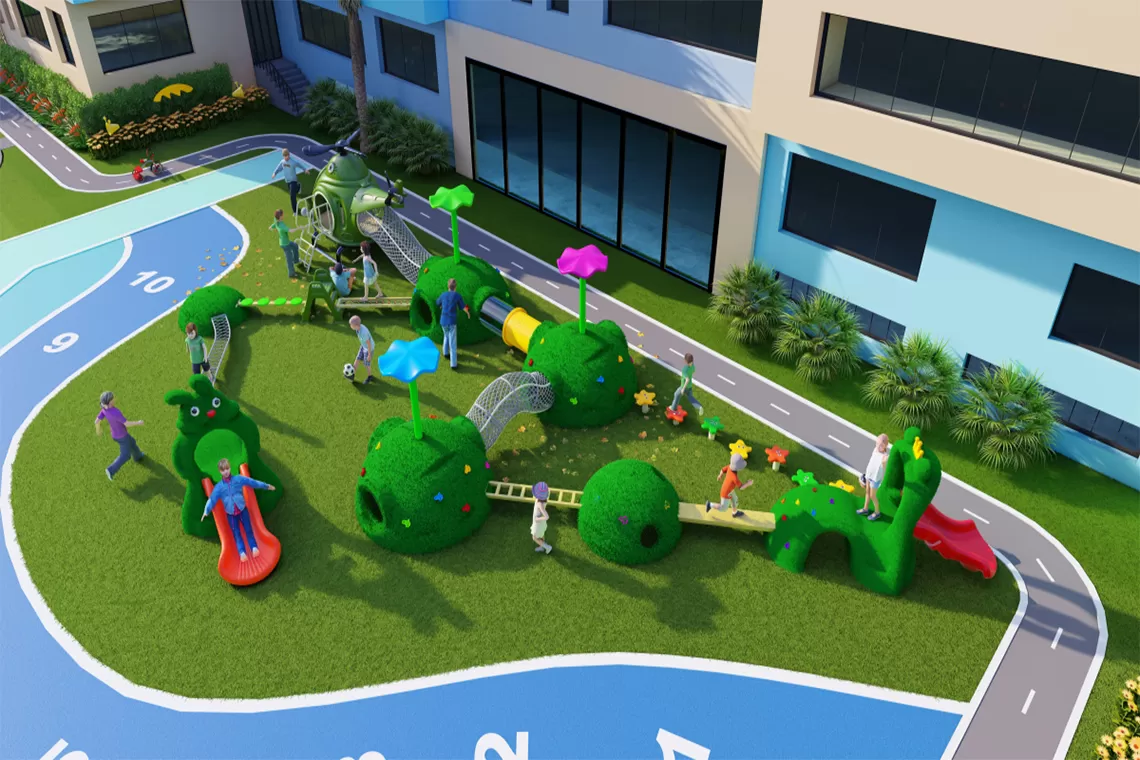
Micro-destinations spread activity across the space. Instead of one concentrated area that either works or does not, multiple freestanding nodes create several reasons to be outside simultaneously — different ages, different activities, different corners of the courtyard all in use at once.
Low-disruption upgrades keep the space current. Adding a new spinner or replacing a worn climber module does not require the courtyard to close for weeks. The rest of the space stays operational while one element is serviced or exchanged.
The social magnet effect builds community organically. Children using the equipment draw parents outdoors. Parents present in a shared space create the conditions for spontaneous neighbour interaction. Active, occupied courtyards are perceived as safer and better maintained — which directly influences resident renewal decisions.
Understanding all the components prevents the most common under-specification mistake: purchasing the play equipment while omitting the elements that make the space genuinely usable.
| Component | Function | What Happens Without It |
|---|---|---|
| Play modules (age-appropriate) | The primary play destinations | Space is installed but age-inappropriate; underused |
| Safety surfacing | Impact absorption under and around fall zones | First injury creates liability and potential closure |
| Shade and seating | Parent comfort; longer dwell time | Parents become uncomfortable and leave with children |
| Circulation design | Clear pathways, accessible routes, sightlines | Congestion, conflict, and supervision difficulty |
| Age zoning and signage | Separates developmental levels; sets expectations | Older children overwhelm younger; parents disengage |
| Drainage consideration | Prevents pooling under surfacing | Surfacing degrades faster; space becomes unusable after rain |
Optional additions that expand the space's appeal:
Inclusive elements (wheelchair-accessible spinners, ground-level activities)
Sensory play panels for children with additional needs
Adult fitness stations positioned adjacent to children's play
Evening lighting for year-round and extended-hour use
Freestanding play equipment creates flexible micro-destinations that activate communal spaces without permanent heavy construction.
| Factor | Freestanding | Integrated Playground |
|---|---|---|
| Installation complexity | Lower — individual footings | Higher — coordinated structure |
| Phased investment | Yes — add modules over time | No — primarily one project |
| Tight courtyard fit | Excellent — distribute nodes | Challenging — needs contiguous space |
| Visual landmark impact | Moderate — distributed presence | High — single strong focal point |
| Flexibility to evolve | High | Low once installed |
A single hero spinner or climber works well for very small courtyards or as a first-phase investment. A multi-node layout — three to six smaller stations distributed across the space — typically generates higher total usage, serves a wider age range simultaneously, and creates more natural social clustering.
| Input | Why It Matters |
|---|---|
| Available dimensions | Determines node count and spacing |
| Resident age mix | Drives equipment type selection and age zoning |
| Supervision model | Affects sightline and layout design |
| Noise sensitivity | Some equipment (spinners, active climbers) generates more sound |
| Maintenance capacity | Simpler moving parts reduce ongoing maintenance burden |
| Budget and phasing preference | Freestanding allows stage 1 / stage 2 planning |
| Setting | Why It Works Here |
|---|---|
| Apartment communities and HOAs | Courtyard activation; resident retention; amenity differentiation |
| Co-living and student housing | Social catalyst; compact installation in shared outdoor areas |
| Mixed-use residential developments | Family-friendly activation of retail and residential shared zones |
| Community centres and pocket parks | Flexible programming; phased upgrade without full reconstruction |
| Hospitality shared courtyards | Extended guest dwell time; family-friendly brand positioning |
| Benefit | Commercial and Resident Impact |
|---|---|
| Higher communal space utilisation | Space is actually used daily, not just on weekends |
| Stronger resident satisfaction | Families with children report higher satisfaction when outdoor play is available |
| Better safety perception | Active, populated spaces feel safer — reducing crime perception concerns |
| Phased capex planning | Budget can be distributed over 2–3 years as usage data builds |
| Faster installation | Individual freestanding elements install significantly faster than large custom structures |
| Resident retention signal | Amenity investment communicates that management values long-term residents |
| Risk | Consequence | Prevention |
|---|---|---|
| Poor placement near units | Noise complaints and resident conflict | Buffer distance planning; directional orientation away from windows |
| Inconsistent surfacing or drainage | Accelerated wear and post-rain unusability | Specify surfacing to fall height and drainage requirements from the outset |
| Wrong age mix for the community | Equipment sits unused if it mismatches resident demographics | Survey resident age profile before specifying modules |
| Under-specified materials | Corrosion and fading within 18–24 months in coastal or high-UV environments | Require anti-UV and anti-corrosion material specifications in writing |
| No maintenance plan | Gradual deterioration; eventual closure; negative reviews | Request a maintenance schedule and spare parts list at handover |
Site photos and dimensions with surface condition noted
Target age groups and estimated peak daily usage
Climate environment: high UV, coastal salt exposure, significant rainfall
Accessibility requirements and relevant local standards
Budget range and phasing preference (all at once or staged)
Any known noise sensitivity or proximity to windows or units
Multi-node layout suggestion with spacing and sightlines indicated
Safety surfacing recommendation matched to fall heights
Full bill of materials with anti-UV and anti-corrosion coating specifications
Warranty terms and spare parts availability
Installation guidance and site preparation requirements
Recommended maintenance schedule at handover
| Frequency | Actions |
|---|---|
| Daily / Weekly | Visual check for debris, loose parts, sharp edges, surfacing displacement |
| Monthly | Fastener tightening, spinner bearing inspection, corrosion check on fittings |
| Seasonal | Deep clean, coating touch-up, surfacing top-up or repair, drainage inspection |
| Ongoing | Keep a small spare kit: end caps, bolts, spinner bearings — prevents long downtime closures |
Operational tip: assign one maintenance team member ownership of the play equipment inspection log. A visibly maintained space is itself a resident communication — it signals that management cares about the shared environment. An unmaintained space generates the opposite signal within weeks.
Q1: What is freestanding play equipment and how is it different from a standard playground?
Freestanding play equipment refers to standalone or modular play structures installed as independent units rather than as part of a single integrated structure. The key difference is flexibility: individual elements can be added, repositioned, or upgraded independently without affecting the rest of the installation. This makes freestanding equipment significantly better suited to phased investment, evolving resident demographics, and tight courtyard spaces.
Q2: Is freestanding play equipment suitable for very small courtyards?
It is often ideal for small spaces precisely because of its flexibility. Compact individual modules can be distributed to maintain clear walkways and supervision sightlines in ways that a single large integrated structure cannot. A courtyard that cannot accommodate a traditional playground can typically accommodate three to four freestanding nodes with appropriate spacing and surfacing.
Q3: Do freestanding structures require safety surfacing?
In most cases, yes. The requirement depends on the fall height of the equipment, the equipment type, your local safety standards, and the site's drainage conditions. Lower-profile items like balance beams and spring riders have different surfacing requirements than a freestanding tower with elevated access. Always specify surfacing alongside equipment — purchasing equipment without matching surfacing creates both safety and compliance risk.
Q4: How do I choose modules that work for multiple resident age groups?
Use age zoning as the organising principle: low-level sensory and rocking elements for toddlers (1–3 years), moderate climbers and spinners for primary-age children (4–10 years), and optional fitness or challenge elements for older children and adults. Distributing these across the space rather than concentrating them in one area reduces conflict between age groups and increases the total proportion of residents who find something relevant to their household.
Q5: Can freestanding play equipment be expanded after the initial installation?
Phased expansion is one of the primary advantages of freestanding play equipment over integrated structures. Many communities begin with a core set of three to five elements and add new modules in subsequent budget years as usage patterns emerge and resident needs evolve. Plan for future expansion at the initial specification stage — ensure surfacing coverage, electrical conduit for future lighting, and pathways are sized for the final vision, not just the first phase.
Freestanding play equipment works best when it is specified as a complete system: the right modules for your resident age mix, appropriate safety surfacing, integrated shade and seating, and a maintenance plan that keeps the space operating to the standard residents expect. Suppliers who provide layout guidance, material specifications, and a handover maintenance schedule make the project easier to approve and easier to manage long-term.
Visit our freestanding play product page and share your site dimensions, target age groups, and preferred style to receive a recommended layout plan and quotation for your communal space activation project.