 Factory & Production
Use milestones, dated photos, checklists and exception records to verify playground equipment production progress before shipment.
Read insight


To choose outdoor slides for a kindergarten, start with the target age group, the usable site size and shape, the type of slide, platform and climbing difficulty, required safety zones, impact-attenuating surfacing, supervision routes, outdoor material specifications, installation and maintenance responsibilities, and the local standards or regulations that apply to the project. Do not approve a slide from a product photo alone. Ask the supplier to place the proposed equipment on a confirmed site plan and identify the information, drawings and product-specific documents that will be provided.
Last updated: July 2026
Choosing outdoor slides for a kindergarten is a planning decision, not a color-selection exercise. The slide, access route, platform, surrounding activity area, surfacing, drainage and teacher sightlines should work together for the children who will use the space and for the requirements that apply at the project location.

Kindergarten children are not one uniform user group. Their balance, reach, grip, climbing confidence, judgment and need for adult support can vary considerably. A useful brief therefore describes the children who will normally use the play area, whether different groups will use it at different times, and whether the layout needs separate zones.
For younger or less confident users, planners may consider easier access, shorter play routes, clearer transitions and activities that allow children to enter or leave without crossing a difficult element. Older or more confident kindergarten users may be ready for more varied climbing, longer routes or additional activity choices. These are planning considerations, not universal age rules. Final age suitability and dimensional decisions should be confirmed against the selected equipment, project design and applicable local requirements.
Mixed-use sites benefit from clear zoning. A smaller play route can sit near a more active combination structure without forcing every child onto the same platform. Seating, open activity space and quiet areas can also help teachers manage different play needs.
Open plastic slides make the route and exit easy to see. They can work in compact or moderate-size layouts and may be supplied as straight, wave or curved forms. The selected size, side protection, surface condition and exit area must match the complete equipment design.
Tube slides create a more enclosed experience and can support a themed design. They may need a larger or more carefully oriented footprint, and teachers should consider visibility at the entrance and exit. Ventilation, drainage, inspection access and component connections should be reviewed with the supplier.
Stainless steel slides may be suitable where a project calls for a particular shape, landscape integration or material finish. Surface temperature, orientation, shade, finish, supports and local climate require attention. “Stainless steel” alone does not confirm the grade, construction or suitability for a site.
A combination structure connects one or more slides with platforms, steps, ramps, panels, bridges or climbing elements. It can provide more activities in one footprint, but the route difficulty, user flow and supervision sightlines must remain clear.
Nature-themed slides may use landscape colors, tree-house forms, animal details or panels that fit the surrounding environment. The theme should support the play experience without hiding access points, inspection areas or structural connections. For more on how site data becomes a design proposal, see the custom playground equipment design process.
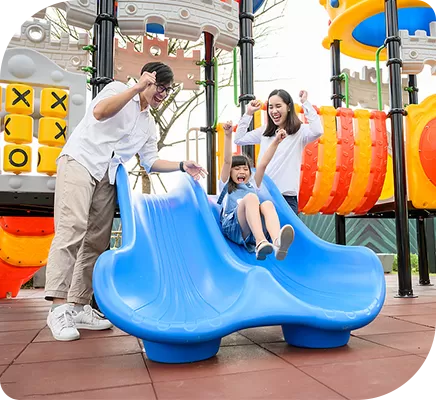
Platform height is only one part of difficulty. The access method, spacing of steps, hand support, slope, route length, guardrails, openings and the transition into the slide all affect how a child uses the equipment. A low platform with an awkward access route may be less appropriate than a carefully planned structure with clearer movement.
Ask the designer to identify the intended user group and show the complete route on the layout and product drawings. If a structure contains different difficulty levels, the transition between them should be understandable to teachers and children. Avoid copying one platform height from a different country or product and treating it as a global rule. The final dimensions should be confirmed for the exact model, configuration, site and applicable requirements.
The playground plan should show more than the equipment footprint. It should account for the slide exit area, fall zones, entrances, circulation routes, guardrails, openings, nearby trees or walls, and any other equipment with moving or high-activity areas. Children should not step out of a slide into a busy crossing route.
Impact-attenuating surfacing is selected as part of the project design. The material, installed depth or system, sub-base, drainage and maintenance method depend on the site and applicable requirements. Grass, paving or a decorative surface should not be assumed to provide the required impact performance.
Drainage matters because water can collect around exits, footings and low areas. The site plan should also preserve teacher sightlines. A visually impressive element should not create an unseen space that is difficult to supervise. Project-specific fall-zone, opening and surfacing requirements must be confirmed with the local authority, consultant or other responsible project party and against the applicable standard.
Material descriptions should be specific enough for comparison. Depending on the confirmed design, a kindergarten slide system may use galvanized steel structures, powder-coated metal parts, LLDPE plastic components, HDPE panels, stainless steel slide sections, outdoor-treated wood, and stainless steel or other specified fasteners. Not every project uses every material.
Ask for the material specification, dimensions or thickness where relevant, surface finish, connection method and any applicable material or component report. Plastic is not automatically “completely waterproof, corrosion-free, non-toxic and environmentally friendly.” Wood is not automatically harmless or equal in service life to every other material. Durability and material suitability depend on the actual specification, manufacturing, exposure, use, inspection and maintenance.
Climate should be part of the specification. Strong sunlight, high humidity, salt exposure, freezing conditions or heavy rainfall may affect color, coatings, metal selection, drainage and maintenance planning. A manufacturer should explain how the proposed material schedule relates to the destination environment without making a universal service-life promise.
Start with the location of entrances and exits. Teachers should be able to understand where children enter the play route, where slides discharge, and how children circulate back to the beginning. Avoid layouts in which a child crosses a swing path or crowded slide exit to reach another activity.
Consider sightlines from the normal supervision positions, not only from the center of the site. Trees, buildings, fences, decorative panels and tall equipment can create blind spots. Quiet activity areas and active climbing or sliding areas can be separated while remaining visually connected. Seating should not block circulation, and boundaries should be treated as real design constraints.
For a broader school-site discussion, review outdoor playground equipment for schools.
A standard playground model can shorten the initial selection process when its footprint, functions and appearance already fit the site. The buyer should still confirm the exact configuration, site layout, surfacing, installation and documents for the ordered model.
A custom design is useful when the site is irregular, the kindergarten has a specific theme or color system, functions need to be adjusted, or the equipment must coordinate with buildings and landscape features. Custom does not mean that every part is invented from zero. It can combine established components with a project-specific layout, theme, access route or functional mix.
Custom changes may affect structure, materials, dimensions and the applicability of existing test documentation. These changes should be reviewed before approval rather than after production begins.
If the project team is comparing companies rather than choosing the slide type, use the children’s slide manufacturer buyer checklist to review quotation scope, materials, drawings, documents, production, packing and installation responsibilities.
Factory information: registered company details, factory location and the party responsible for the order.
Material specifications: the materials and finishes for the actual proposed equipment.
Applicable test reports: documents whose product model, configuration and scope can be compared with the order.
Design drawings: site layout, product or production information as agreed in the project scope.
Installation drawings: foundation, post positioning, component identification and assembly guidance where applicable.
Packing list: shipment contents and component organization.
Spare parts: agreed spare hardware or replaceable components.
After-sales communication: a clear contact and process for installation questions, missing parts or maintenance needs.
Do not accept the phrase “complete certificates” without checking what each document is, who issued it, which product it covers and whether it is relevant to the destination. The playground test report guide explains the difference between standards, reports and model scope.
A useful design request includes site dimensions and units, site photos, a CAD or marked layout when available, the target age group, expected capacity, preferred theme and colors, ground condition, installation method, destination country, and an approximate budget range. Add the position of buildings, trees, walls, gates, utilities, slopes and drainage features.
The destination country helps the supplier prepare for a project discussion, but it does not allow the supplier to determine every legal or approval requirement. The buyer, consultant, importer and local authority should confirm which standards, permits, inspections and documents apply.
Use the playground equipment quotation information guide to prepare a more complete request.

The suitable type depends on the children, site, access route, supervision, safety zones, surfacing, climate and applicable local requirements. Open, tube, stainless steel, combination and themed slides can all be appropriate in the right project configuration.
Yes. A project may adjust the layout, theme, colors, play functions, access route and selected components. Structural or material changes may affect technical review and test-document applicability, so they should be confirmed before production.
Depending on the design, materials may include galvanized steel structures, powder-coated metal parts, LLDPE components, HDPE panels, stainless steel slide sections, treated outdoor wood and specified fasteners. Buyers should request the material schedule for the exact proposal.
There is no single global clearance number for every slide. The required space depends on the selected equipment, slide exit, fall zones, circulation, nearby features, surfacing and applicable project requirements. It should be shown on the approved site plan.
Local installation may be possible when the team has suitable skills, tools, site preparation and clear drawings. The buyer and supplier should agree on responsibility for foundations, unloading, assembly, anchoring, surfacing and final checks before shipment.
Request the quotation and confirmed specification, layout and product drawings, applicable product-specific test reports, packing list, installation information, maintenance guidance and other documents required by the project parties.
ZZRS Playground supports commercial playground projects with site-based design, equipment production, packing and installation information. To discuss a kindergarten slide project, send the usable site size and units, photos or drawings, target age group, preferred theme and functions, ground condition, approximate budget, destination country and port, and the planned installation method. Review outdoor playground equipment or contact ZZRS Playground to start a project-specific discussion.
Practical guidance from playground planning, manufacturing, delivery and completed project experience.
Factory & Production
 Buying Guide
 Buying Guide