 Buying Guide
Compare 10 Canadian playground equipment manufacturers and suppliers by manufacturing evidence, product focus, regional support, CSA documentation and project fit.
Read insight

Quick answer: buyers should verify the standard version, named model and configuration, report scope, dates, laboratory details and local authority requirements before relying on an EN 1176 or ASTM F1487 document. EN 1176 and ASTM F1487 are two playground safety standards that buyers may reference when planning or procuring public-use playground equipment. They are not universal approvals for every country or every product. Before relying on a document, check its title, standard version, issuing or testing organization, report or certificate number, named product and model, tested configuration, test scope, dates and laboratory information. Then confirm whether the exact ordered equipment and the local project requirements are covered.
Last updated: July 2026
Important scope notice: Playground standards, testing requirements, import documentation and local approval procedures vary by country, project type and local authority. A certificate or test report applies only to the products, models, configurations and test scope stated in the document.
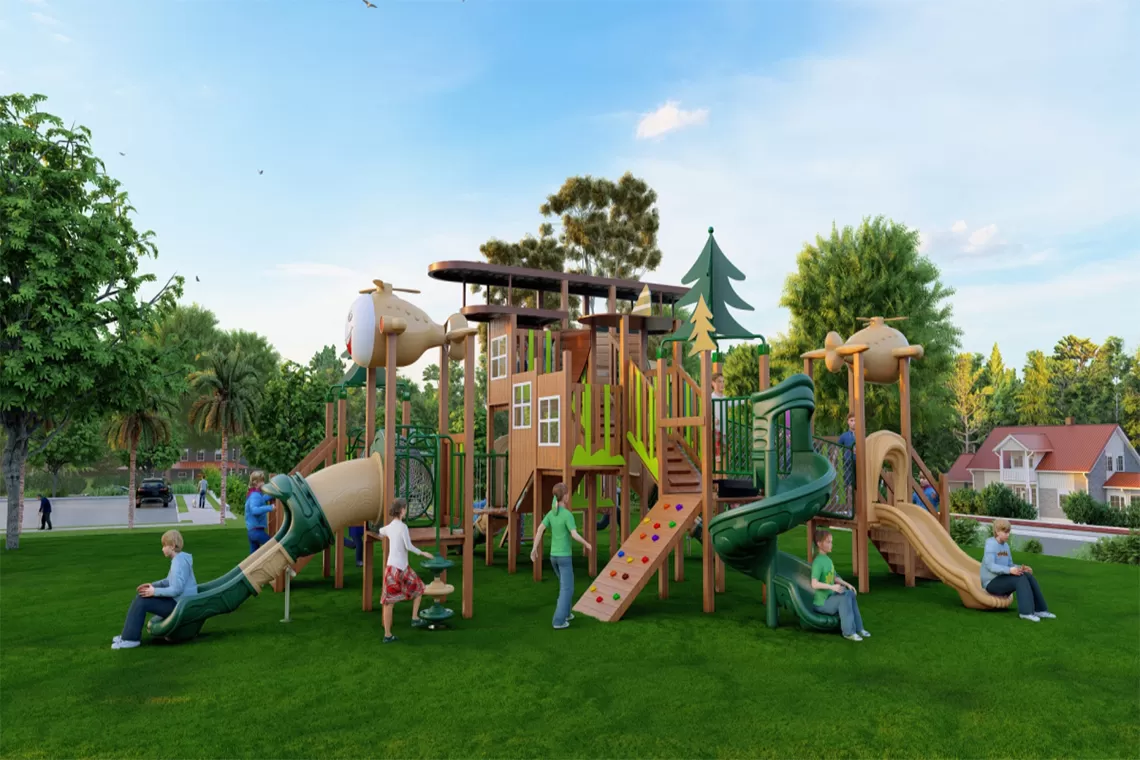
EN 1176 is a European series of standards for playground equipment and surfacing. Different parts address general requirements and requirements for particular equipment types. A project may need to identify the relevant parts, editions and national or local implementation rather than referring only to “EN 1176” as a broad label.
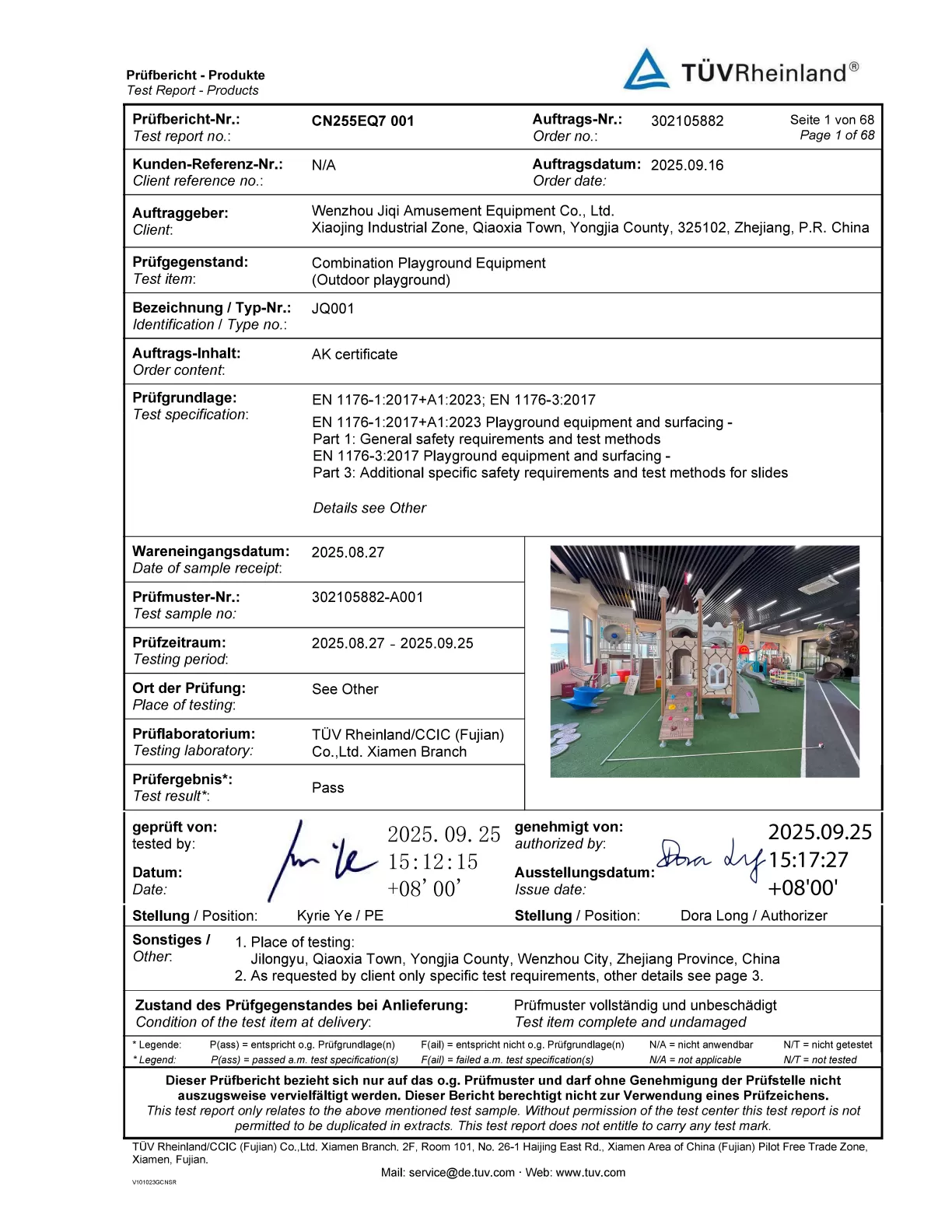
A test report prepared against selected EN 1176 requirements records what was assessed and the result for the stated test item and scope. It does not automatically confirm that every product from the same supplier, every custom variation or the completed project site complies with all applicable requirements.
ASTM F1487 is a standard consumer safety performance specification for playground equipment for public use. It is commonly discussed in North American procurement and design contexts, but the requirements that apply to a specific project can involve additional standards, laws, accessibility provisions, owner specifications and local approval processes.
An ASTM F1487 test report does not automatically establish CPSIA compliance, ADA compliance, customs-clearance approval, insurance approval or complete approval for every North American project. Those questions must be addressed through the specific documents and authorities responsible for the project.
Buyers should not use “certificate” as a general name for every technical document. Common document types have different purposes:
Certificate: a formal document issued under a defined certification scheme and subject to its stated scope and conditions.
Test report: a record of testing or evaluation for the test item, configuration, standard clauses and scope stated in the report.
Declaration: a statement made by the manufacturer or another responsible party; it is not the same as independent testing.
Material report: a document addressing a material or component property; it does not by itself assess the complete playground.
Product-specific test: an assessment tied to the model, sample or configuration identified in the document.
Factory management system certificate: evidence that a management system was assessed against a stated management standard and scope. It is not a product test report.
These documents may support different parts of a procurement review, but they cannot be substituted for one another.
Use the following checklist before accepting a report or certificate as evidence for an order:
document title and document type;
standard name and version;
issuing, certification or testing organization;
report or certificate number;
product name and model;
tested sample or configuration;
clauses, exclusions and stated test scope;
issue date and validity date where applicable;
laboratory or assessment-site information;
the company or client name printed on the document;
whether the document applies to the exact ordered product.
Ask for the complete relevant document when a first-page image does not show the scope, exclusions or conditions needed for review. Confirm the document directly with the issuing or testing organization when project procedures require that step.
A report for one model must not be described as coverage for an entire product line. A product name that sounds broad, such as “combination playground equipment,” should still be read together with the model, tested sample, drawings and report scope.
Custom playground projects can change dimensions, materials, access routes, slides, platforms, connections or structural arrangements. These changes may affect whether an existing test report is relevant. The responsible project parties should decide whether the change can be evaluated against existing documentation or requires additional technical review or testing.
Buyers should also separate product assessment from site acceptance. Foundations, installation, surfacing, clearances, drainage and maintenance conditions are site matters that may not be covered by a product test report.
Before placing an order, ask the relevant project parties which standards, permits, inspections and documents are required. Depending on the project, this may include the local authority, project consultant, inspector, contractor, importer and insurance provider.
Provide the supplier with the destination country, project type and any written technical specification. A supplier can then compare the request with available product documents, but should not promise that one report guarantees approval, prevents customs problems or satisfies every stakeholder.
Depending on the product model, order and available documentation, ZZRS can discuss:
applicable EN 1176 test reports;
applicable ASTM F1487 test reports;
ISO management system certificates;
material or component reports where available;
product and project drawings;
installation documents associated with the confirmed order.
The document name, holder, report number, model, issue date and scope should be copied from the actual document, not reconstructed from marketing text. If a required detail is not available during review, record it as {{待核实}} and request the supporting file before publication or procurement approval.
See the current ZZRS safety standards, test reports and certifications page for related document information. The custom playground design process explains why product configuration should be confirmed before manufacturing.
No. A report applies to the product, model, configuration and test scope stated in the document. Other products and custom changes require their own scope review.
No. Accessibility, import, insurance and local approval requirements should be checked separately with the responsible project parties and relevant documents.
No. An ISO management system certificate and a product test report serve different purposes and should be presented separately.
Send the selected product, model or drawing, proposed configuration, destination country, project specification and the exact document requirement from the consultant, authority or importer.
To review documentation for a planned order, contact ZZRS Playground with the product model or drawing, site and project type, destination country, applicable requirement supplied by the project team, and expected order configuration. ZZRS will identify the available documents for that specific request without extending their scope beyond what the documents state.
Practical guidance from playground planning, manufacturing, delivery and completed project experience.
Buying Guide
 Buying Guide
 Factory & Production