 Factory & Production
Use milestones, dated photos, checklists and exception records to verify playground equipment production progress before shipment.
Read insight


Quick answer: Buyers should select unpowered amusement equipment by comparing play function, intended users, movement, safety area, surfacing, foundations, supervision, inspection and maintenance. Unpowered equipment creates play through gravity, balance, climbing, rotation, swinging and the user’s own movement, and can include modular systems, freestanding events, sensory activities and landscape-based play.
Last updated: July 2026
Published by ZZRS Amusement Equipment Co., Ltd. (ZZRS Playground).

Classify equipment by play function and site requirements before selecting a catalogue model.
The term generally describes recreational equipment in which motion comes from the user, gravity or stored mechanical movement such as a spring. It can be installed in schools, parks, residential communities, resorts, commercial recreation areas and child-care settings. Some projects use “non-powered playground equipment” or simply “playground equipment” for the same broad group.
Unpowered does not mean technically simple. Moving parts, fall zones, climbing heights, foundations, entrapment considerations, material durability and inspection all require attention. The final requirements depend on equipment type, configuration, destination and intended users.
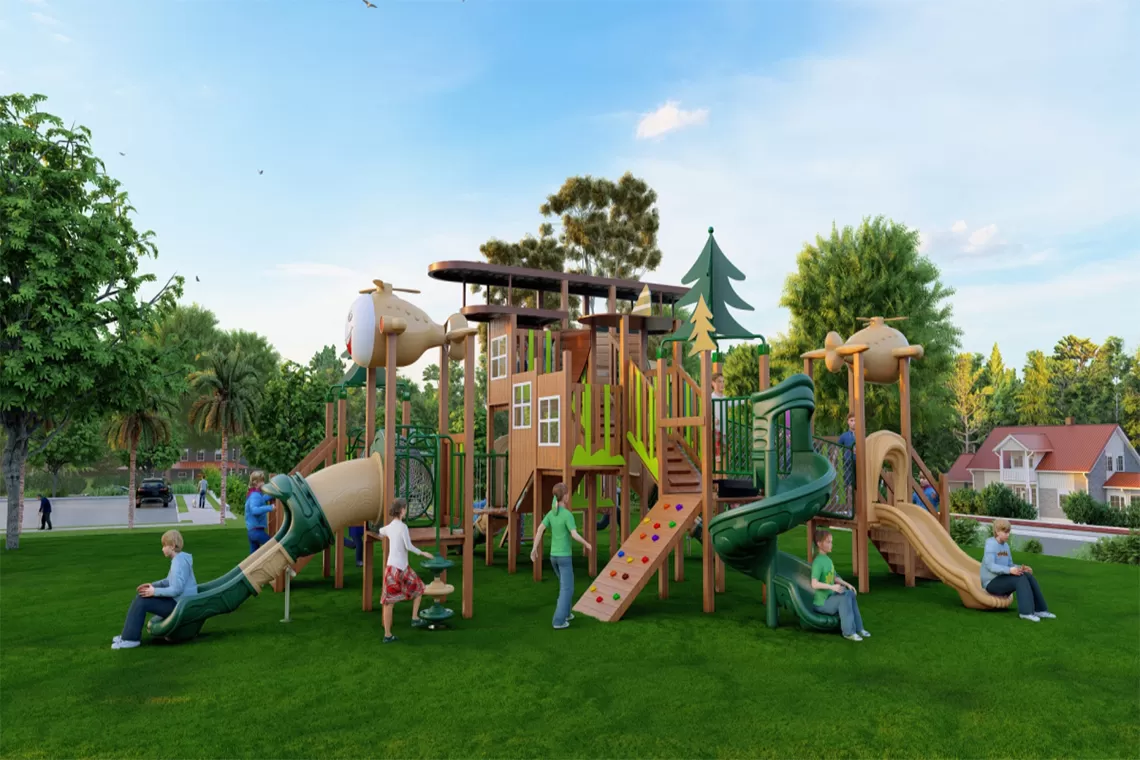
Composite structures connect platforms, access points, bridges, climbers, panels and slides into one system. They can provide a recognizable centerpiece and several play routes within a coordinated footprint. Standard catalogue models offer a defined starting point, while modular configurations adjust compatible components around the site.
Review platform levels, entry and exit circulation, difficulty progression, ground-level activities, supervision, safety area and the way users move between the main structure and nearby equipment. Large size alone does not guarantee balanced play value.
This group includes nets, climbing walls, ladders, overhead events, balance beams, stepping elements and rope structures. It supports coordination, strength, route planning and graduated challenge. Equipment can be independent or connected to a larger system.
Buyers should consider intended age and ability, grip and foothold design, fall height, user flow, rope and connector specifications, inspection access and replacement methods. Challenge should be deliberate and understandable rather than created by unexpected gaps or unclear routes.
Slides may be straight, curved, spiral, open, enclosed, embankment-mounted or connected to platforms. They use gravity and are often combined with climbing access to create a repeatable movement loop. Material, orientation and local climate can affect surface temperature and user experience.
Confirm access, platform height, slide geometry, exit area, support structure, connections and surrounding circulation. A slide should not discharge into a path, swing zone or congested area.
Swings create pendulum motion and can use belt seats, cradle seats, inclusive seats, group seats or other designs. Because their movement extends beyond the frame, their use zone and circulation require careful planning. Users should not need to cross through a moving swing path to reach another activity.
Inspect hangers, chains or ropes, seats, bearings, connections, frame stability and surfacing. Seat type and suspension details should match the intended users and supplier’s approved configuration.
Spinners, carousels and rotating platforms create circular movement through user push or body weight. They can support social and vestibular play, but capacity, speed control, entry, hand support and clear surrounding space must be reviewed for the exact product.
Maintenance focuses on bearings, fasteners, rotating interfaces, foundations, clearances and wear. Do not infer safe capacity from visual size; use the approved product information.
These activities create rocking movement through springs, pivots or flexible supports. Single-user spring riders can fit smaller areas, while multi-user rockers and seesaws add cooperative play. Check seat or standing position, hand and foot supports, pinch or crush points, movement range and the surrounding zone.
Springs, pivots and anchors are wear items that need routine inspection. Replacement components should match the original design rather than being selected only by appearance.
Panels, musical elements, sand or water activities, play counters, steering components, talk tubes and themed enclosures can create social, imaginative and sensory play without elevated access. They are important for activity variety and can provide options for users who do not enter a climbing structure.
Review reach ranges, maneuvering space, sound impact, drainage, movable parts, hygiene and maintenance. “Inclusive” should be supported by the actual route, access and activity design rather than used only as a product label.
Obstacle courses combine stepping, balancing, crawling, climbing and overhead movement in a sequence. They may serve children, families or older users depending on the design. The route should have clear entry and exit points, suitable challenge progression and enough space for waiting and bypassing.
Confirm user group, event difficulty, fall considerations, surfacing, supervision and whether the course is intended for timed competition or open recreation. Avoid assuming that equipment designed for one age or setting transfers directly to another.
Nature-inspired play may use timber, rock-like climbers, mounds, logs, planting, sand and water to create a less prescriptive environment. Some elements are manufactured equipment; others are landscape features. The project team should define which standards, inspection methods and professional responsibilities apply to each part.
Drainage, material durability, splinters, loose parts, erosion, plant selection and visibility are part of the operating plan. Natural appearance does not remove the need for documentation and maintenance.
| Category | Primary play experience | Key planning question |
|---|---|---|
| Composite structure | Connected routes and multiple activities | Does the complete route fit the site and users? |
| Climbing and balance | Challenge, strength and coordination | Is difficulty progressive and inspectable? |
| Slides and swings | Gravity and repeated motion | Are movement zones separated from circulation? |
| Spinners and rockers | Rotation or oscillation | Are moving interfaces and clearances controlled? |
| Ground-level activity | Social, sensory and imaginative play | Can intended users reach and use the activity? |
| Obstacle or nature play | Open-ended route and landscape experience | Who owns design, inspection and maintenance? |
Map the site: usable boundaries, entrances, slope, drainage, utilities, existing features and installation access.
Define users: age groups, abilities, supervision pattern, expected frequency and project type.
Build the activity mix: movement, challenge, social, sensory, imaginative and quieter options.
Review movement zones: safety areas, circulation, waiting, sightlines and separation of fast-moving activities.
Confirm technical scope: materials, foundations, surfacing, drawings, documents, packing and installation.
Plan operations: inspection frequency, maintenance capability, replacement parts and record keeping.
Start with the site-planning guide, then use the freestanding play equipment guide to balance the main structure with independent activities. If the site also serves adults or older users, compare the separate types of park exercise equipment and their functions before mixing fitness stations with children’s play routes.
Requirements depend on equipment, users, destination and configuration. Confirm the applicable standard or authority expectations, the report or document scope, foundation details, surfacing and completion inspection before tender or approval. See the playground standards guide for evidence questions.
Commercial equipment is normally shipped in classified components for on-site assembly. The installer should follow approved drawings and foundation information, record deviations and complete a final check. Operation should include routine visual checks, scheduled detailed inspections, maintenance records and a process for closing damaged equipment until repaired.
No. Designs can serve children, families, teenagers or adults, but the equipment and challenge level must be selected for the intended users.
The play equipment itself generally does not use an external motor, though the site may still need power for lighting, security or other facilities.
It depends on the model and movement zone. Swings, long slides, large structures and obstacle routes can require substantial surrounding space. Use the project-specific layout.
Yes. A strong project often combines a main structure with swings, spinners, sensory panels or climbing activities, provided circulation and use zones are coordinated.
Send site dimensions or drawings, photos, destination, project type, users, preferred activities, budget range, schedule and installation plan.
Share the site plan, destination, users and preferred activities. ZZRS can review an appropriate mix of composite and freestanding equipment and identify the details required before quotation.
Discuss the Site PlanPractical guidance from playground planning, manufacturing, delivery and completed project experience.
Factory & Production
 Buying Guide
 Buying Guide